Low wage
jobs
have been a big part of the so-called recovery. What they also signify
is a more troublesome trend that continues to eat away at the
middle class in this country. I’ve noted that the per capita
average income for Americans is $25,000
and many seem to be shocked when they hear how low this figure is. A
recent presentation only reinforces this figure by discussing the number
of working Americans in low wage fields. The problem with having such a
large portion of our population in low wage work is that as the cost of
living goes up many of these people have a harder time providing for
necessities like food, education, and also
healthcare.
Surprising or not, the nation has been seeing a massive divide between
the working class and those at the top. The low wage employment growth
signifies a continuation of this trend.
Number of Americans in low wage jobs
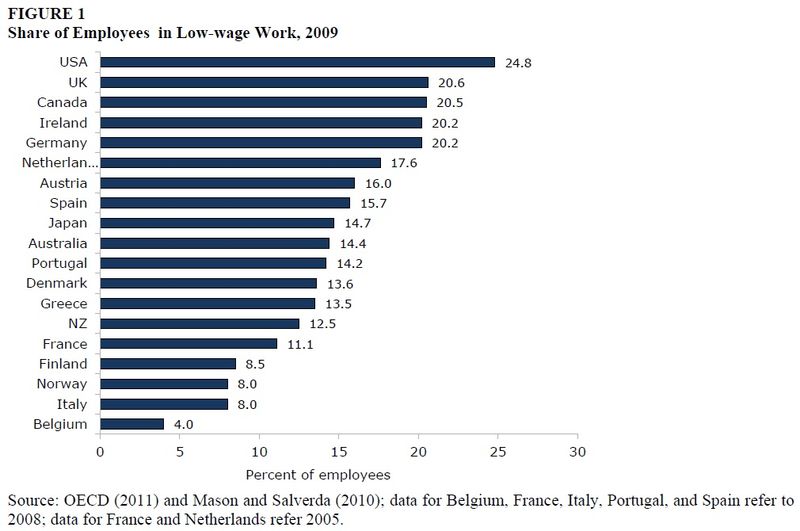
An interesting chart below was presented by economist Tim Taylor. The
chart is illuminating:

Source:
Conversable Economist
Taking a look at some of the industrialized nations with higher
incomes in the world and the US has one of the largest numbers of those
employed working in low wage fields. It is helpful to define what low
wage work is; low wage work is
employment
positions that pay less than $10 an hour. It is an interesting trend
that has continued for well over three decades. A large portion of
Americans are working in lower wage work (assuming they have work). The
$25,000 per capita average of income doesn’t seem so farfetched when
one out of four employed Americans find their source of employment to be in the low wage segment of the economy.
An interesting observation is made by Tim Taylor:
“The issue here can be summed up with this question: If
someone in the U.S. economy is a law-abiding citizen who works full-time
for a period of years, can they earn a level of wages that let them
afford a slice of middle-class standard of living? If you are earning
$10/hour and working 2,000 hours per year, your annual earnings of
$20,000 would put you below the poverty line of $22,891 for a single
parent with three children.”
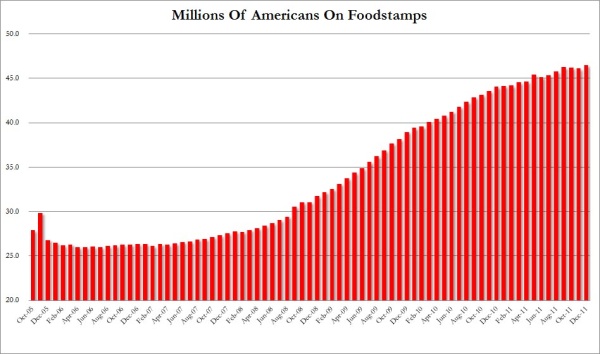
This fact also highlights the large silent numbers that we see with Americans on
food stamps. Some are part of the working poor. Over
46,000,000 Americans are receiving some form of food assistance today:

Source: Zero Hedge
You can see how quickly things went up from 25 million or so before the recession hit to 46 million today. Is this really a
recovery? Not if we define a recovery as paving the road to a
middle class lifestyle
for many Americans. Much of this path has been paved over even in the
last couple of decades. The 2000s appeared on the surface to usher in
prosperity for Americans but in reality, wages were stagnant and all the
outward signs of spending came from
diving deep into unsustainable levels of debt.
Now that we are dealing with the aftermath of deleveraging people are
realizing a growing divide in our country that is becoming more
prominent and hard to ignore.
The growing divide
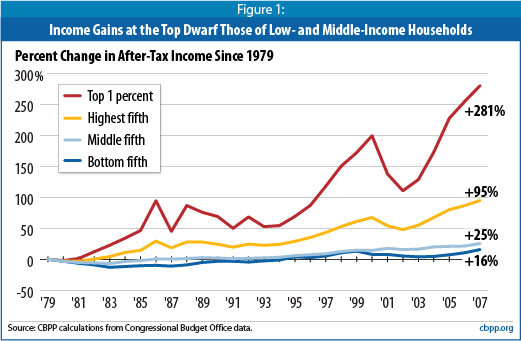
Some parts of the country have done exceptionally well in the last few decades:

Most of the gains have come to the top one and five percent of the
nation. While those in the middle fifth of income saw income rise by 25
percent since the 1970s those in the
top 1 percent
have seen a stunning 281 percent average jump. Those on the low income
segment have done much worse seeing only a 16 percent rise in income.
These are issues we need to explore since it appears the
middle class
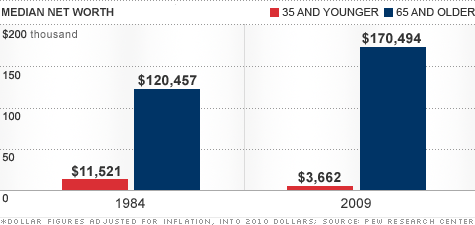
is disappearing in our country. The stock market may be up over 100
percent since the low days of 2009 but most Americans have very little
invested so it really hasn’t changed their lives:

Most Americans, especially the young have little invested in anything. Part of this comes from the massive number working in
low wage fields.
When examining employment trends we find that some of the top number of
jobs for the future will come from lower wage sectors. How much as a
nation do we value having a strong and vibrant middle class? You can’t
call it a middle class when a large portion of employees are at the
bottom.